
Why Most Hydration Advice Fails Endurance Athletes
March 16, 2026 · 4 min read

For decades, hydration advice in endurance sport has followed a familiar script: drink regularly, stay ahead of thirst, and replace fluids lost through sweat. While this guidance was intended to help athletes avoid dehydration, modern research has revealed that the physiology of hydration during prolonged exercise is far more complex.
The central issue is that hydration is often framed as a fluid problem, when in reality it is a fluid and electrolyte problem, with sodium playing the dominant role. Athletes lose both water and sodium in sweat, yet most hydration advice focuses almost exclusively on replacing fluid. This mismatch between what is lost and what is replaced explains why many endurance athletes still experience cramps, fatigue, dizziness, and gastrointestinal distress despite drinking plenty during training or racing.
Understanding why hydration advice often fails begins with understanding what actually leaves the body during exercise.
Sweat Is Not Just Water
When the body sweats, it is attempting to regulate internal temperature by evaporating fluid from the skin. Sweat is composed primarily of water, but it also contains electrolytes, the most abundant of which is sodium.
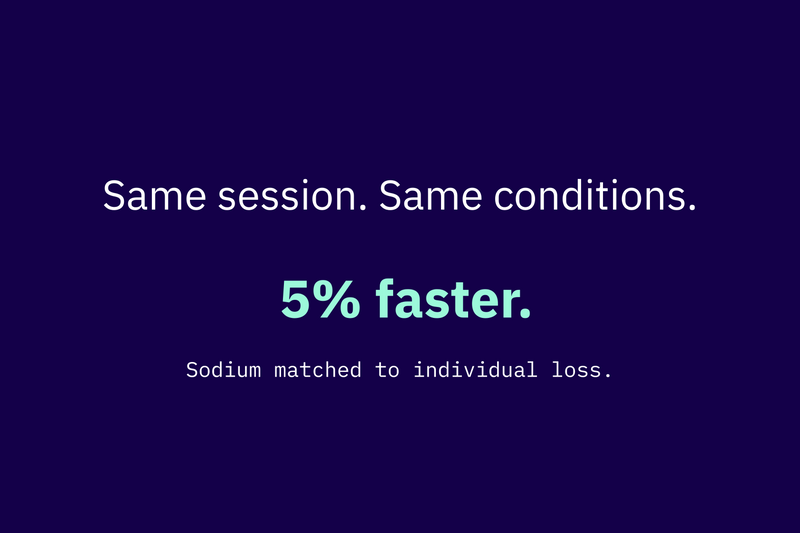
The concentration of sodium in sweat varies widely between individuals. Research has shown that sweat sodium concentrations can range from approximately 200 mg per litre to over 2000 mg per litre, meaning two athletes exercising under identical conditions may lose dramatically different amounts of sodium. [1]
Sweat rate itself also varies significantly depending on factors such as temperature, humidity, exercise intensity, clothing, and individual physiology. Many endurance athletes lose between 0.5 and 2.0 litres of sweat per hour, with some exceeding this range in hot conditions. [2]
When these two variables—sweat rate and sweat sodium concentration—are combined, the result is that athletes can lose hundreds to several thousand milligrams of sodium per hour during prolonged exercise.
Hydration strategies that focus solely on fluid replacement therefore address only half of the equation.
The Limits of “Drink More Water”
One of the most persistent beliefs in endurance sport is that dehydration is the primary threat during long events. As a result, athletes are often encouraged to drink as much fluid as possible to avoid performance decline.
However, replacing large volumes of water without sufficient sodium can dilute the concentration of sodium in the bloodstream. In severe cases, this can lead to exercise-associated hyponatremia (EAH), a condition characterised by abnormally low blood sodium levels caused by excessive fluid intake relative to sodium replacement. [3]
EAH has been documented in numerous endurance events, including marathons, Ironman triathlons, and ultra-endurance races. Symptoms can range from mild confusion and nausea to seizures and life-threatening complications in extreme cases.
Importantly, the risk of hyponatremia is not driven solely by sodium loss, but by the imbalance between fluid intake and sodium concentration. Athletes who drink large amounts of water while replacing little sodium are at the greatest risk.
This highlights a key flaw in traditional hydration advice: simply encouraging athletes to drink more fluid does not guarantee better hydration or improved performance.
Individual Variation Changes Everything
One of the main reasons hydration advice often fails is that it is typically presented as a one-size-fits-all recommendation.
In reality, hydration requirements differ dramatically between athletes. Sweat rate can vary more than threefold between individuals performing the same exercise, and sweat sodium concentration can vary by up to tenfold. [4]
These differences mean that two athletes following the exact same hydration strategy could experience completely different outcomes. One athlete may replace fluid and sodium appropriately, while another may under-replace sodium despite drinking large volumes of fluid.
Environmental conditions add further complexity. Heat and humidity can substantially increase sweat rate, while altitude and intensity changes can alter fluid requirements throughout a race or training session.
Because of this variability, effective hydration strategies must account for individual physiology rather than relying on generic guidelines.
A More Complete Hydration Strategy
Modern endurance nutrition strategies increasingly recognise that effective hydration requires managing both fluid intake and sodium replacement.
Fluid intake primarily supports thermoregulation and blood volume, helping maintain cardiovascular stability during prolonged exercise. Sodium, meanwhile, plays a critical role in maintaining fluid balance, nerve signalling, and muscle contraction.
Rather than treating hydration as a single variable, athletes benefit from thinking of it as a system with multiple inputs. Fluid intake can be adjusted based on sweat rate and environmental conditions, while sodium replacement can be tailored to individual sweat sodium concentration and total sweat loss.
This approach allows athletes to maintain electrolyte balance without relying on fixed-ratio sports drinks that may not match their physiological needs.
Practical Application
In practice, many endurance athletes adopt a flexible hydration strategy that separates fluid intake, sodium replacement, and energy intake.
A typical setup may involve drinking water according to thirst or a personalised fluid plan, while replacing sodium through electrolyte drinks or capsules and consuming carbohydrates through gels, chews, or other fuels.
This approach allows each variable—fluid, sodium, and carbohydrate intake—to be adjusted independently based on race conditions and individual needs.
For example, if temperatures increase during an event, an athlete can increase fluid and sodium intake without altering carbohydrate intake. Similarly, if gastrointestinal discomfort occurs, the athlete can modify fluid or fuel intake independently.
The result is a more adaptable and physiologically aligned strategy.
The Takeaway
Hydration during endurance exercise is not simply a matter of drinking enough water. It is the result of balancing fluid intake with sodium replacement while accounting for large individual differences in sweat rate and electrolyte loss.
Traditional hydration advice often fails because it oversimplifies this process and assumes that all athletes lose and require the same amounts of fluid and electrolytes.
By understanding the roles of both fluid and sodium in endurance performance, athletes can develop hydration strategies that better match their physiology, reduce the risk of electrolyte imbalance, and support sustained performance during training and racing.
References
[1] Baker, L. B., Stofan, J. R., Hamilton, A. A., & Horswill, C. A. (2009). Comparison of regional patch collection vs. whole body washdown for measuring sweat sodium and potassium loss during exercise. Journal of Applied Physiology, 107(3), 887–895. https://doi.org/10.1152/japplphysiol.00197.2009
[2] Sawka, M. N., Cheuvront, S. N., & Carter, R. (2005). Human water needs. Nutrition Reviews, 63(6), S30–S39. https://doi.org/10.1111/j.1753-4887.2005.tb00152.x
[3] Hew-Butler, T., Rosner, M. H., Fowkes-Godek, S., et al. (2015). Statement of the Third International Exercise-Associated Hyponatremia Consensus Development Conference. Clinical Journal of Sport Medicine, 25(4), 303–320. https://doi.org/10.1097/JSM.0000000000000221
[4] Baker, L. B. (2017). Sweating rate and sweat sodium concentration in athletes: a review of methodology and intra/interindividual variability. Sports Medicine, 47(S1), 111–128. https://doi.org/10.1007/s40279-017-0691-5

Get the next article.
Evidence-led writing on hydration, sodium, and protocols. Direct to your inbox. No noise.
You are on the list.
The next article will land in your inbox.
Educational content. Not medical advice. Individual hydration needs vary — consult a qualified practitioner for personalised guidance.