
What the First 50 Profiles Told Us About How Endurance Athletes Actually Fuel
April 21, 2026 · 8 min read
Fifty endurance athletes built a personalised hydration profile in the first night after launch. The patterns in the data confirm what the research has predicted for years — and surface a few gaps in how athletes are currently fuelling that are worth naming directly.

When we opened the hydration profile builder to the public, we expected it to confirm a lot of what the research predicts about individual variation in sodium loss. The first night of responses did that — and surfaced a few patterns we were not expecting. Here is what the data is showing.
In the twenty-four hours after we opened the hydration profile builder to the public, around fifty endurance athletes built a personalised profile. The tool asks athletes to input their physiology, the conditions they are training or racing in, the session they are preparing for, and their current hydration strategy. It returns an individualised fluid, sodium, and carbohydrate target — and, in that first night of responses, it gave us a dataset showing how a broad cross-section of endurance athletes actually approach the problem of fuelling long efforts.
The dataset is small and early. We are not drawing statistical conclusions from it. But the patterns that emerged across those first fifty profiles are consistent enough to be worth describing, because they point to practical gaps in how athletes are currently fuelling — gaps that the research has predicted for years, and that the data is now putting specific numbers to.
The variance is real, and it is larger than most athletes assume
The clearest pattern in the data is also the one most directly supported by the published research: sodium loss varies enormously between individuals, even between individuals who look similar on paper.
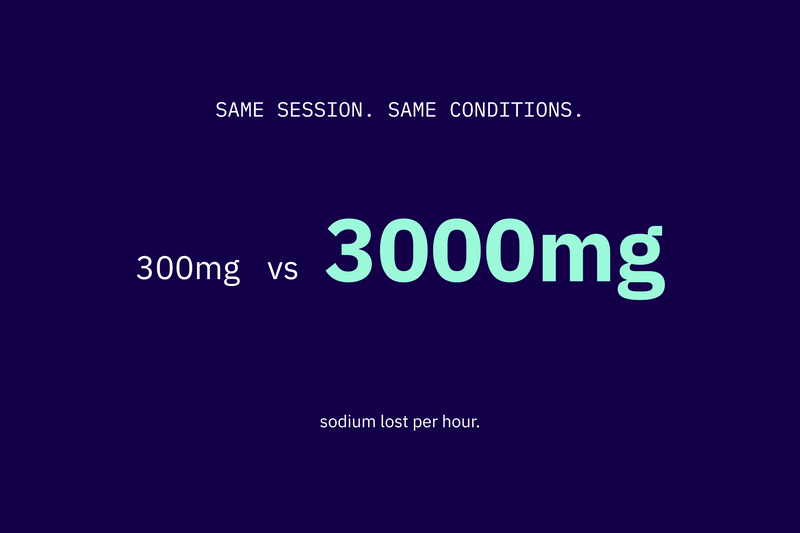
Across the profiles built so far, estimated sodium loss per hour ranged from approximately 360 mg to 4,770 mg. That is a thirteen-fold difference. The athletes at the low end and the athletes at the high end are not training for different sports. They are not exclusively elite or exclusively recreational. They are the same kind of athlete — predominantly triathletes and long-course runners — preparing for the same kinds of events in comparable conditions.
What separates them is physiology. And physiology, as the research on sweat sodium concentration has consistently shown, is not something athletes can intuit from the outside. [1]
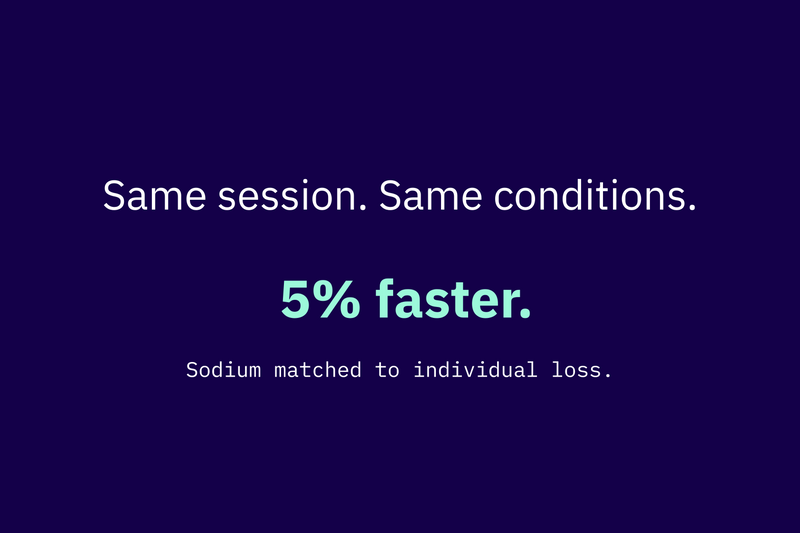
The practical consequence is that the sodium intake that would leave one athlete well-replaced would leave another athlete several grams into deficit by the end of a long session. An intake of 1,000 mg per hour is a comfortable surplus for an athlete losing 400 mg per hour. The same intake is a significant deficit for an athlete losing 2,500 mg per hour. Both of those athletes exist in the early-responder data. Both are preparing for events of similar length. Neither can be adequately served by the same product at the same dose.
This is the structural problem the research has been describing for more than a decade. The data is now showing it at scale, in the athletes actually using the tool.
Most athletes are fuelling long events without knowing what is in their drink
The second pattern is less about physiology and more about current practice. Of the profiles built so far, only around one in three athletes had a clear picture of the sodium content in their current in-session drink. Roughly the same proportion were training or racing on water alone. The remaining third were using an electrolyte or carbohydrate-and-electrolyte drink but were unsure of its actual sodium concentration.
Combined, more than half of responders were entering long sessions — the median session length in the dataset is four and a half hours — with either no meaningful sodium replacement or no clear idea of how much they were getting.
Half of the athletes using water-only strategies also reported a cramping history.
There is a practical, education-level gap here that is worth naming directly. Sodium replacement is not complicated as a concept, but it requires knowing two numbers: how much sodium is in what you are drinking, and roughly how much you are losing. A meaningful portion of experienced endurance athletes — including those who have been in the sport long enough to have developed a cramping history — do not currently have access to the first number, let alone the second.
The research on sodium and performance is only useful if it is actionable. It becomes actionable when athletes can see the gap between what they are losing and what they are replacing. For most of the athletes in the early dataset, that gap has been invisible until now.
Most athletes will hit the gut's absorption ceiling before they replace their sweat
The third pattern is the one we did not fully anticipate, and it is the one with the most immediate practical implications for how athletes think about hydration.
Of the early profiles, more than eight in ten produced a recommended hourly fluid intake that was capped by gut absorption capacity rather than by sweat loss. In plain terms: the athlete's body was losing more fluid per hour than the gut could practically absorb in the same period.
The average sweat rate in this capped group was 1.92 L per hour. The average fluid intake the calculator could safely recommend was 879 ml per hour. That is a fluid deficit of just over one litre per hour — a deficit that accumulates for every hour the session continues, regardless of how disciplined the athlete is about drinking to plan.
This is consistent with what the research on intestinal absorption has shown for some time. The gut can absorb fluid at a reasonably predictable rate during exercise, and that rate has an upper limit — typically in the range of 1,000 to 1,200 ml per hour even in well-trained athletes. [2] Above that ceiling, additional fluid intake does not translate into additional absorption. It sits in the stomach, produces gut discomfort, and ultimately either slows the athlete down or is expelled.
For athletes with sweat rates of 1.5 L per hour or more — which describes a majority of the early-responder dataset — this has two direct implications.
The first is that "drink more" stops being a useful piece of advice at a certain point. The second is that if absolute fluid replacement is not achievable during the session, the composition of the fluid being absorbed becomes disproportionately important. If you can only take in 900 ml per hour against a 2 L loss, the sodium concentration of those 900 ml determines whether your plasma volume holds or collapses over a long event.
This is the case for separating sodium from fluid intake — not as a stylistic preference, but as a practical response to a physiological constraint. When you cannot replace fluid one-for-one, you have to replace the electrolytes in that fluid at a higher concentration than conventional sports drinks provide. Capsule-based sodium delivery is not a marketing distinction. It is a direct consequence of the gut absorption ceiling that most endurance athletes are running into without realising it.
Heat is arriving before heat readiness
The fourth pattern is smaller in the dataset but worth noting because of its timing. Of the profiles built for sessions in conditions above 28°C, roughly two-thirds were entered by athletes who described themselves as only partially acclimated — or not acclimated at all.
Heat acclimation takes approximately ten to fourteen days of consistent exposure to meaningfully change the body's thermoregulatory response. [3] The Australian summer race season continues to extend, and early-season races are now regularly held in conditions that substantially exceed athletes' recent training environments. The gap between the conditions athletes are racing in and the conditions they have prepared in is a predictable source of underperformance — and the early data suggests this gap is common.
None of this is resolved by hydration strategy alone. But it does mean that the sodium and fluid strategy of an un-acclimated athlete in 30°C+ conditions needs to account for the fact that their sweat response will be less efficient than a heat-adapted athlete's. They will sweat later, sweat saltier, and lose more total volume at a given workload. [4] The practical consequence is that the same athlete may need a noticeably different strategy for a hot race than for the temperate training block that preceded it.
What the early data is telling us
The patterns described above are not surprising individually. Each of them is consistent with what the published research predicts. What is striking is how consistently they appear across the early-responder dataset — and how clearly they point to the same underlying issue.
A significant portion of endurance athletes are approaching long events with a fuelling strategy that is under-matched to their physiology. Some are under-replacing sodium because they do not know how much they lose. Some are over-drinking fluid that their gut cannot absorb, without compensating in sodium concentration. Some are preparing for conditions their body has not yet adapted to. In most cases, the athlete's training is not the limiting factor. The strategy that surrounds the training is.
What the data reinforces, more than anything else, is that individualisation is not a marketing concept. It is a practical necessity. The thirteen-fold variance in sodium loss across the early dataset is not an outlier finding — it is the baseline reality of working with a diverse population of endurance athletes. Any fuelling approach that does not account for that variance is, by definition, serving some athletes well and others poorly.
The purpose of the profile builder was never to sell a product. It was to give athletes the two numbers they need to make informed decisions: what they are likely losing, and what they would need to replace it. The early responses suggest that, for most athletes, one or both of those numbers have been missing until now.
We will share more of what the data reveals as the sample grows. For athletes who have not yet built a profile, the calculator remains the most direct way to see where your own fuelling strategy sits against your own physiology — and where the practical gaps are that the published research has been describing for years.
References
[1] Baker, L. B. (2017). Sweating rate and sweat sodium concentration in athletes: a review of methodology and intra/interindividual variability. Sports Medicine, 47(S1), 111–128. https://doi.org/10.1007/s40279-017-0691-5
[2] Jeukendrup, A. E. (2014). A step towards personalized sports nutrition: carbohydrate intake during exercise. Sports Medicine, 44(S1), 25–33. https://doi.org/10.1007/s40279-014-0148-z
[3] Périard, J. D., Racinais, S., & Sawka, M. N. (2015). Adaptations and mechanisms of human heat acclimation: applications for competitive athletes and sports. Scandinavian Journal of Medicine & Science in Sports, 25(S1), 20–38. https://doi.org/10.1111/sms.12408
[4] Buono, M. J., Ball, K. D., & Kolkhorst, F. W. (2007). Sodium ion concentration vs. sweat rate relationship in humans. Journal of Applied Physiology, 103(3), 990–994. https://doi.org/10.1152/japplphysiol.00015.2007
Get the next article.
Evidence-led writing on hydration, sodium, and protocols. Direct to your inbox. No noise.
You are on the list.
The next article will land in your inbox.
Educational content. Not medical advice. Individual hydration needs vary — consult a qualified practitioner for personalised guidance.