
Bolus or Distributed? What the Research Says About Sodium Dosing Timing
April 07, 2026 · 5 min read

One question came up consistently in our athlete field testing program: does it matter when you take sodium, or just how much you take across a session?
Specifically — is it better to take a larger dose less frequently (a bolus), or smaller doses spread more evenly across the hour?
It's a legitimate question, and the answer has practical implications for how you structure your capsule protocol. Here's what the research says.
What we mean by bolus vs distributed dosing
Bolus dosing means taking a larger amount at once, less frequently — for example, 700mg of sodium every hour in a single hit.
Distributed dosing means spreading the same total amount across smaller, more frequent doses — for example, 350mg every 30 minutes to reach the same 700mg/hr target.
With a 350mg capsule, this distinction is simple: one capsule every 30 minutes is distributed dosing. One capsule every hour is a lower total dose. Two capsules at once each hour would be a bolus of 700mg.
The question is whether the timing of that delivery changes the outcome.
What the research tells us
Sodium absorption during exercise is not like carbohydrate absorption
Carbohydrates have well-established timing windows — the literature on carbohydrate feeding frequency during exercise is clear that consistent delivery maintains blood glucose more effectively than infrequent large doses.
Sodium behaves differently. It is absorbed rapidly through the small intestine and distributed into extracellular fluid relatively quickly. Unlike carbohydrates, the body has regulatory mechanisms — primarily the kidneys and sweat glands — that modulate sodium balance continuously throughout exercise, regardless of how it arrives.
A 2025 review published in Performance Nutrition (Springer Nature) found that what matters most for sodium during exercise is not the timing of delivery but the relationship between sodium and water — specifically, maintaining plasma sodium concentration across the session. The total sodium delivered relative to losses matters more than the frequency of dosing.
Plasma sodium concentration is the target, not delivery rate
Research consistently shows that the primary goal of sodium supplementation during endurance exercise is to attenuate the decline in plasma sodium concentration that occurs through sweat losses and fluid intake. Studies by Anastasiou et al. and Twerenbold et al. both demonstrated that even modest amounts of sodium — delivered in standard drink form across a session — were sufficient to attenuate plasma sodium decline compared to water alone.
The mechanism here is osmolality. Sodium's role is to maintain the osmotic pressure of extracellular fluid, which drives fluid retention and supports plasma volume. This process doesn't require a spike in sodium delivery — it requires sustained availability across the session.
What about large single doses?
High-dose sodium supplementation (900mg/hr) was examined by researchers studying thermoregulation in endurance athletes (PMC, 2015). The finding: high-dose supplementation during long-duration exercise did not significantly affect sweat rate, perceived heat stress, or time to exhaustion compared to placebo. Performance was not measurably different.
This doesn't mean sodium doesn't matter — it means that above a functional threshold, timing and size of individual doses appear to matter less than total session delivery relative to individual sweat losses.
What the research does flag as a risk with large bolus doses is the potential for temporary osmotic imbalance if a large sodium hit is taken without adequate fluid. Sodium draws water into the extracellular space osmotically. A large dose with insufficient fluid can transiently increase plasma osmolality and trigger thirst — which is useful if you need to drive drinking, but not ideal if you're already managing fluid intake carefully.
The case for distributed dosing in practice
While the research doesn't definitively declare one approach superior at the physiological level, there are practical arguments for distributing sodium intake across a session:
Gut tolerance. Smaller, more frequent doses are generally better tolerated in the gastrointestinal tract during exercise, when blood flow is diverted away from the gut. One of our field trial athletes who was already consuming approximately 1,455mg of sodium per hour from other sources experienced mild GI discomfort and a subjective feeling of being over-salted — a clear illustration of the ceiling effects of sodium stacking, not bolus timing specifically, but a relevant signal.
Consistency. Five of seven athletes in our field testing program reported that capsules made them more consistent in their sodium intake across the session. This is the more practical benefit of a structured dosing interval — not that the physiology demands it, but that it creates a system athletes actually execute under effort.
Matching loss rate. Sweat sodium loss is continuous, not intermittent. Matching intake pattern to loss pattern — even approximately — is more logical than allowing large deficits to accumulate before a single correction.
So what does this mean for your protocol?
The evidence supports this conclusion: total sodium delivered relative to your individual sweat rate matters more than whether you take it in one hit or multiple smaller doses per hour.
However, in practice, distributing your intake — one capsule every 20–30 minutes rather than two capsules once an hour — has real advantages:
- Lower GI stress per dose
- More consistent plasma sodium maintenance across the session
- Better habit formation under race conditions, where forgetting a dose is easier the longer the interval
- Easier to adjust mid-session (add a capsule if conditions worsen, rather than deciding whether to double a dose)
The Lytework dosing protocol recommends 1 capsule every 20–30 minutes as a baseline, adjusted for heat, sweat rate, and session length. This isn't arbitrary — it reflects both the physiological rationale for consistent sodium delivery and the practical reality of execution under effort.
A note on individual variation
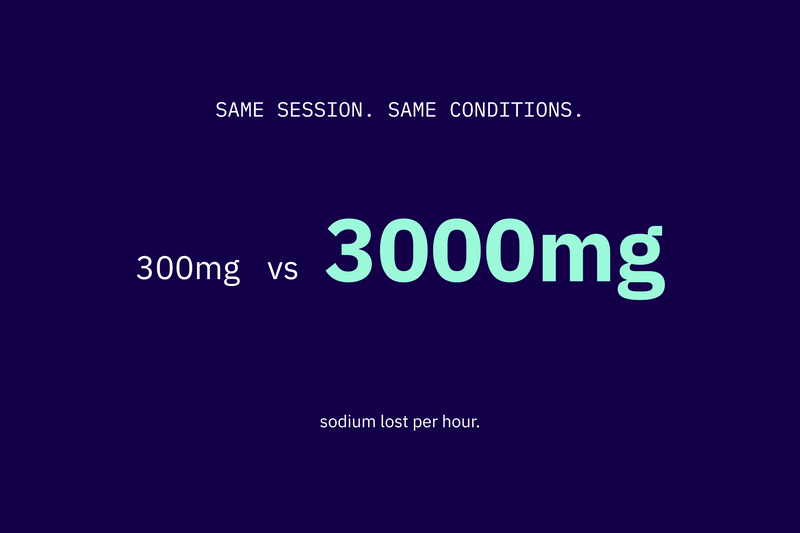
None of this accounts for the variability that exists between athletes. Sweat sodium concentration can vary up to 10× between individuals (Holmes et al., 2016), and sweat rate varies significantly with intensity, heat acclimatisation, and body mass. The correct dosing interval for a heavy, salty sweater racing in 32°C is not the same as for a moderate sweater in mild conditions.
This is why protocol personalisation matters more than a universal timing rule. Use your sweat profile — through our Hydration Intelligence calculator or a field sweat test — to establish your baseline, then apply the timing structure that keeps you consistent under the specific demands of your session.
References
- Anastasiou CA et al. — sodium and plasma volume during exercise in the heat, PMC
- Twerenbold R et al. — sodium ingestion during 4-hour running time trial
- Holmes N et al. (2016) — sweat rate and sodium loss in endurance athletes, Journal of Sports Medicine and Research
- PMC (2015) — effects of high-dose sodium supplementation on thermoregulation in endurance athletes
- Springer Nature (2025) — sodium intake for athletes before, during and after exercise: review and recommendations, Performance Nutrition
- ACSM Position Stand — exercise and fluid replacement
- Systematic Review (2018) — impact of sodium ingestion during exercise on endurance performance
Lytework Labs is currently in athlete field testing. The Hydration Intelligence calculator is free at lyteworklabs.com.

Get the next article.
Evidence-led writing on hydration, sodium, and protocols. Direct to your inbox. No noise.
You are on the list.
The next article will land in your inbox.
Educational content. Not medical advice. Individual hydration needs vary — consult a qualified practitioner for personalised guidance.