
What Happens to Performance When Sodium Is Right
April 13, 2026 · 7 min read
When sodium replacement matches individual loss, the body sustains plasma volume, reduces cardiovascular strain, and holds performance deeper into long efforts. Here is what the research shows.

Most conversations about sodium and endurance performance focus on what goes wrong when sodium falls short. Cramping, fatigue, late-race deterioration — the familiar list of consequences that athletes have come to accept as part of racing hard.
Less attention is paid to the other side of that equation: what the research actually shows when sodium replacement is adequate and appropriately matched to individual loss.
The distinction matters. Understanding the performance consequences of sodium deficit helps explain why things go wrong. Understanding what adequate replacement enables helps explain what is actually possible — and what many athletes are leaving on the course.
The physiological case for getting sodium right
Sodium's role in endurance performance operates through several interconnected mechanisms. None of them are dramatic in isolation. Together, they determine whether an athlete's body can sustain the demands of prolonged effort or whether it progressively loses the capacity to do so.
The most well-established mechanism is plasma volume maintenance. During exercise, fluid moves out of the vascular compartment through sweating. As this happens, blood becomes more concentrated and plasma volume falls. The consequences are measurable: cardiac output declines, heart rate rises to compensate, and the cardiovascular system works harder to deliver oxygen to working muscles at the same relative intensity. [1]
Sodium is the primary electrolyte governing how much fluid the body retains in the vascular space. When sodium is adequately replaced alongside fluid, plasma volume is better maintained. When it is not, even moderate fluid intake may fail to preserve the vascular volume needed to sustain cardiac output across long efforts. [2]
A second mechanism is the maintenance of plasma sodium concentration itself. As sodium falls relative to total body water — either through direct loss or through dilution from fluid intake without sufficient sodium — serum sodium concentration declines. This affects neuromuscular function: the transmission of nerve signals to muscle fibres becomes less efficient, and sustained muscle contractility under fatigue is impaired. [3]
A third mechanism is thermoregulatory. Plasma volume is not only critical for cardiovascular function but also for the body's ability to shunt blood to the skin for cooling. A fall in plasma volume reduces this capacity, increasing core temperature at a given workload. The athlete does not need to be clinically dehydrated for this to matter. A relatively modest decline in plasma volume is sufficient to raise the cardiovascular cost of a given pace and to increase the perception of effort. [4]
Taken together, these mechanisms describe a system that becomes progressively less efficient as sodium deficit accumulates. The deterioration is rarely sudden. It tends to manifest as a gradual increase in effort at the same output — the familiar experience of maintaining race pace into the second half of an event feeling qualitatively different from the first.
What the research shows
The direct evidence for sodium's effect on endurance performance is more nuanced than is often presented. Several systematic reviews have found that arbitrary sodium supplementation — adding a fixed dose of sodium to a hydration strategy without accounting for individual sweat losses — does not reliably improve performance in temperate conditions. [5]
This finding is often cited as evidence that sodium does not matter for performance. It actually demonstrates something more specific: that undifferentiated sodium intake, applied equally to athletes with very different loss profiles, is unlikely to produce consistent results across a study population. An athlete who loses 400 mg of sodium per hour does not benefit in the same way from sodium supplementation as one who loses 2,000 mg per hour.
The more relevant finding is what happens when sodium replacement is matched to conditions and individual physiology. Studies examining sodium intake in hotter conditions, with higher sweat rates and longer durations, show clearer performance signals. In female cyclists exercising in the heat, sodium hyperhydration — pre-loading sodium to expand plasma volume before exercise — reduced time trial completion time by approximately five percent and enabled a higher sustained power output without any increase in cardiovascular or thermal strain. [6]
In the same study, the performance benefit was attributed specifically to the plasma volume expansion that sodium-facilitated fluid retention produced. The athletes were not working harder. They were sustaining the same physiological output with less cardiovascular cost, because the system supporting that output was better resourced.
This is the performance outcome that adequate sodium replacement enables. Not a dramatic uplift in capacity, but a reduction in the cost of producing a given output — which, across the course of a four- or eight-hour event, compounds into a meaningful performance difference.
The condition specificity of sodium's effect
One of the consistent findings across the research is that sodium's performance impact is condition-specific. In short, cool, lower-intensity exercise, where sweat losses are modest and sodium deficit does not accumulate significantly over the event duration, the performance benefit of sodium supplementation is small and difficult to detect. [5]
As conditions shift — towards heat, longer duration, higher intensity, or higher individual sweat sodium concentration — the performance relevance of sodium replacement increases. This is not a contradiction. It is precisely what the physiology predicts: the mechanisms through which sodium deficit impairs performance only become performance-limiting once sodium losses reach a threshold that the body cannot compensate for through other means.
For the majority of endurance athletes competing in events lasting longer than two hours, particularly in warm conditions or as summer temperatures rise, that threshold is regularly reached. The athletes for whom it is reached earliest, and most severely, are those at the upper end of the sweat sodium concentration spectrum — individuals who may lose two to three times as much sodium per litre of sweat as the average athlete in the same field. [7]
For these athletes, the performance cost of inadequate sodium replacement is not theoretical. It is the accumulated cardiovascular drift, the rising perception of effort in the final third of the race, the legs that stop responding the way they did in the first half. It is the experience of a body running out of the resources it needs to sustain the demand being placed on it.
Recovery and the day after
The performance consequences of sodium management extend beyond the race or training session itself.
Sodium plays a critical role in post-exercise rehydration. After exercise-induced dehydration, consuming fluid without adequate sodium leads to a relatively rapid fall in plasma osmolality — the concentration of particles in the blood — which suppresses the thirst drive and stimulates urine output before fluid balance has been fully restored. The body essentially signals that it has had enough to drink before it actually has. [8]
Sodium intake alongside post-exercise fluid consumption extends the period of fluid retention, supporting more complete restoration of plasma volume and total body water. For athletes training on consecutive days — which describes virtually every athlete in a structured programme — incomplete recovery of fluid and electrolyte balance from one session carries into the next. The accumulation of these deficits over a training week can affect training quality in ways that are difficult to distinguish from inadequate recovery, insufficient carbohydrate intake, or overtraining.
Understanding sodium's role in recovery means understanding that its performance relevance is not confined to race day. It is a daily consideration for any athlete training at volume in conditions that produce significant sweat losses.
What adequate looks like in practice
The research on sodium and performance does not support a single universal recommendation. It supports an individualised approach — one in which the sodium dose is calibrated to the athlete's actual loss rate, the duration and intensity of the effort, and the conditions in which it takes place.
What this means in practice is that adequate sodium replacement cannot be achieved by any fixed-formula product applied uniformly. The athlete who needs 300 mg of sodium per hour and the athlete who needs 2,000 mg per hour are not served by the same product at the same dose. [7]
Separating sodium management from fluid intake — treating them as two distinct variables that can each be adjusted independently — gives athletes the control to match sodium to their individual physiology rather than to a label. This is the structural shift that the research points towards, and the one that makes the performance outcomes described above achievable for athletes across the full spectrum of sodium loss.
The question of how much sodium is right is not answered by the back of a product label. It is answered by understanding how much you lose, and replacing it accordingly.
References
[1] Maughan, R. J., & Shirreffs, S. M. (2010). Dehydration and rehydration in competitive sport. Scandinavian Journal of Medicine & Science in Sports, 20(S3), 40–47. https://doi.org/10.1111/j.1600-0838.2010.01207.x
[2] Anastasiou, C. A., Kavouras, S. A., Arnaoutis, G., Gioxari, A., Kollia, M., Botoula, E., & Sidossis, L. S. (2009). Sodium replacement and plasma sodium drop during exercise in the heat when fluid intake matches fluid loss. Journal of Athletic Training, 44(2), 117–123. https://pmc.ncbi.nlm.nih.gov/articles/PMC2657026/
[3] Shirreffs, S. M., & Sawka, M. N. (2011). Fluid and electrolyte needs for training, competition, and recovery. Journal of Sports Sciences, 29(S1), S39–S46. https://doi.org/10.1080/02640414.2011.614269
[4] Nybo, L., Jensen, T., Nielsen, B., & González-Alonso, J. (2001). Effects of marked hyperthermia with and without dehydration on VO2 kinetics during intense exercise. Journal of Applied Physiology, 90(3), 1057–1064. https://doi.org/10.1152/jappl.2001.90.3.1057
[5] McCubbin, A. J., & Costa, R. J. S. (2018). Impact of sodium ingestion during exercise on endurance performance: a systematic review. Journal of Sports Medicine and Physical Fitness, 8(3). http://article.sapub.org/10.5923.j.sports.20180803.05.html
[6] Garrett, A. T., et al. (2025). Sodium hyperhydration improves performance with no change in thermal and cardiovascular strain in female cyclists exercising in the heat across the menstrual cycle. International Journal of Sport Nutrition and Exercise Metabolism, 35(2), 99–110. https://doi.org/10.1123/ijsnem.2024-0082
[7] Baker, L. B. (2017). Sweating rate and sweat sodium concentration in athletes: a review of methodology and intra/interindividual variability. Sports Medicine, 47(S1), 111–128. https://doi.org/10.1007/s40279-017-0691-5
[8] Shirreffs, S. M., Taylor, A. J., Leiper, J. B., & Maughan, R. J. (1996). Post-exercise rehydration in man: effects of volume consumed and drink sodium content. Medicine & Science in Sports & Exercise, 28(10), 1260–1271. https://doi.org/10.1097/00005768-199610000-00011

Apr 21, 2026
What the First 50 Profiles Told Us About How Endurance Athletes Actually Fuel
Read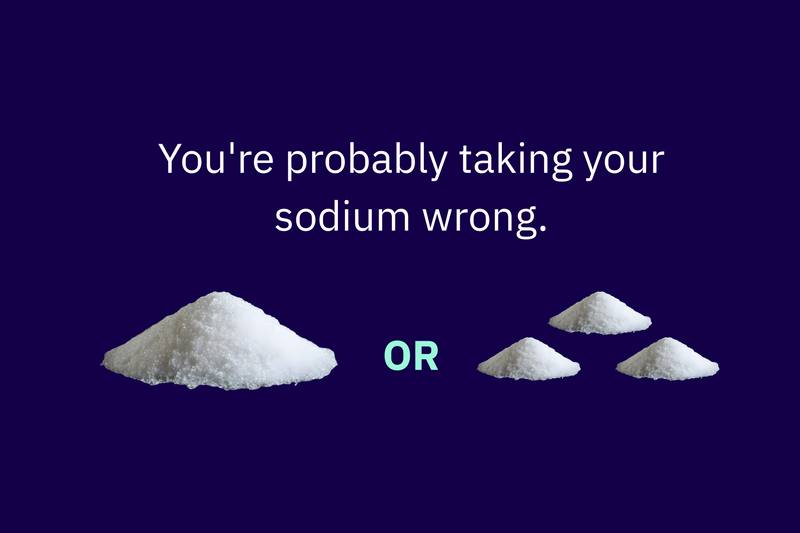 hydration
Apr 07, 2026
Bolus or Distributed? What the Research Says About Sodium Dosing Timing
Read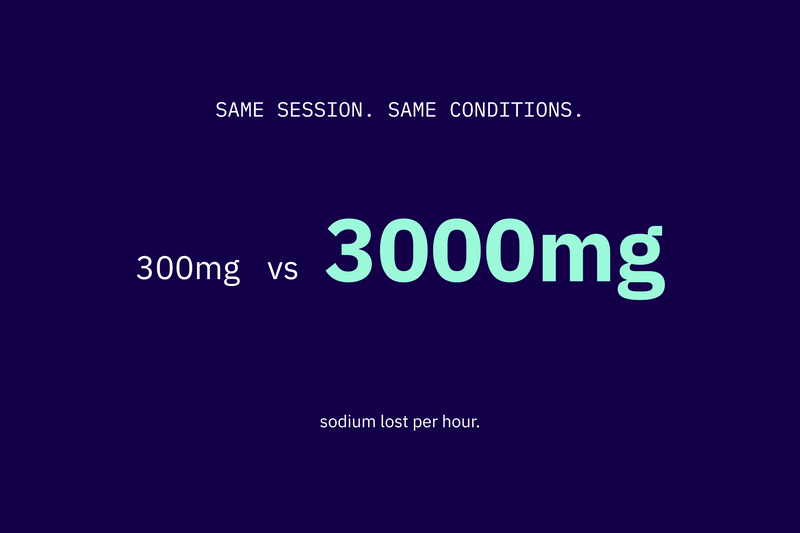 hydration
Mar 30, 2026
How Much Sodium Do You Actually Lose? The Case for Individual Hydration Testing
ReadGet the next article.
Evidence-led writing on hydration, sodium, and protocols. Direct to your inbox. No noise.
You are on the list.
The next article will land in your inbox.
Educational content. Not medical advice. Individual hydration needs vary — consult a qualified practitioner for personalised guidance.